Niu Tou Guai
House of LeavesThe Minotaur is a mythic creature whose traditional story becomes one of the central interpretive models for the labyrinth in The Navidson Record. Presented as both a monster and a concealed child, it gathers together the book’s recurring concerns with forbidden knowledge, distorted architecture, inherited shame, and the danger of turning an unknown being into an object of fear. Its significance lies less in a confirmed physical appearance than in the competing stories built around what may be hidden at the center of the maze.
Mythic Origin and the Labyrinth
The best-known version of the story locates the Minotaur on Crete, in the labyrinth constructed by Daedalus for King Minos at Knossos. The labyrinth served as a prison for a creature born from an illicit encounter between the queen and a bull. Traditionally, the Minotaur is said to have devoured more than a dozen Athenian youths every few years before Theseus killed it. This familiar account makes the maze an enclosure designed to contain a dangerous body, while the creature gives the architecture its apparent purpose.
The text proposes a darker and more intimate explanation. It points out that the myth’s biological premise cannot be taken literally and therefore suspects that Minos did not build the labyrinth to imprison a monster but to conceal his own deformed child. In this reading, the story of the bull and the monstrous offspring is a public fabrication that protects royal pride. Minos avoids murdering his child but creates a structure complicated enough to prevent escape without the visible bars of a conventional prison. The labyrinth thus becomes a form of repression: it hides what the father cannot accept and disguises confinement as something less brutal than imprisonment.
The traditional image of the creature is also corrected. Rather than the centaur-like body often shown in later depictions, the myth describes a man’s body with a bull’s head, or a human being marked by a deformed face. That detail shifts attention from animal savagery to social rejection. The Minotaur is frightening not simply because it is nonhuman, but because the human world has declared a disfigured human heir intolerable.
The Play and the Reversal of Monstrosity
The book develops this interpretation through its account of Taggert Chiclitz’s play The Minotaur, written for the Seattle Repertory Company. The production was seen by only eight people, including the doorman, yet its plot supplies a crucial revision of the myth. Chiclitz begins with Minos entering the labyrinth to speak with his son. The Minotaur, called Mint in the play, is gentle and misunderstood, while the supposed Athenian victims are condemned criminals who have already been sentenced to death in Greece.
Minos normally has these criminals executed secretly and then attributes their deaths to the terrifying Minotaur. The lie keeps the residents of Knossos away from the labyrinth and preserves the fiction that the creature is a murderous beast. When one criminal escapes into the maze and nearly kills Mint, Minos rushes in and kills the attacker himself. The rescue exposes a feeling the king has tried to suppress: he has begun to care for his son, and that recognition produces guilt and sorrow rather than simple paternal authority.
As the play proceeds, Minos learns to see beyond his son’s deformity. He discovers in Mint an elegiac spirit, an artistic sensibility, and a visionary understanding of the world. Paternal love grows slowly, and the king begins imagining a way to return the Minotaur to society. That possibility is destroyed by the story Minos has already told. Theseus arrives as a drunken, almost absurdly brutal figure and hacks the Minotaur into pieces without reflection.
The play’s final irony belongs to Minos. With tears running down his face, he publicly praises Theseus’s courage. The crowd interprets the tears as gratitude, but the audience understands them as grief for a son whose death has been made possible by the father’s own propaganda. Minos continues as a just ruler, yet his justice is permanently shaped by agony. The creature’s destruction is therefore not the triumph of civilization over monstrosity; it is the final consequence of concealment, fear, and a father’s inability to acknowledge his child openly.
The Minotaur and the Navidson Labyrinth
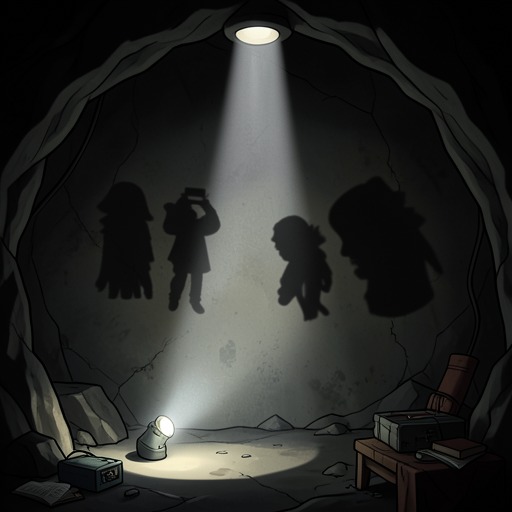
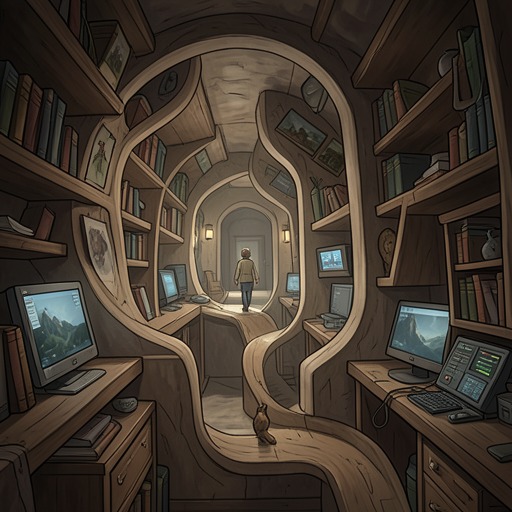
The same questions reappear when Holloway Roberts, Jed Leeder, and Kirby “Wax” Hook descend farther into the stairway during Exploration #4. The vast space resists every stable explanation. It may be an aberration of physics, a spatial warp, or an immense topiary labyrinth, but the text also asks whether it has a funereal purpose, conceals a secret, protects something, or imprisons or hides either a monster or an innocent.
These alternatives deliberately preserve the uncertainty that surrounds the Minotaur. The house offers no confirmed creature and no final account of its architecture. Instead, it produces a series of possible centers: a monster, an innocent, a secret, a burial place, or an absence that only appears monstrous because human observers need an explanation. The labyrinth’s function remains unavailable to the explorers, just as the Minotaur’s true identity remains unavailable within the myth.
The comparison also separates Will Navidson from Minos. Navidson did not build the labyrinth; he discovered it. The paternal figure responsible for the place, whether Minos, Daedalus, a divine father, or another absent ancestor, has vanished, leaving the creature inside to forget, consume, and endure the consequences of its fate. In this formulation, Navidson encounters an inherited structure rather than creating the original repression. His investigation may expose the pattern, but discovery does not grant him the authority to resolve it.
Myth, Fear, and the Creature in Darkness
The Minotaur belongs to a larger contest between rational explanation and mythic belief. The text states that myth destroys reason whenever reason falters, and identifies myth with the monster associated with Tom Navidson, Holloway’s beast, and the Minotaur. The black, faceless figure in Navidson’s house becomes an incarnation of many myths rather than a single creature with a securely defined anatomy.
That multiplication matters. The Minotaur is not merely one possible monster inside the house; it is a name for the pressure exerted by whatever cannot be seen, mapped, or assimilated. The labyrinth promises a center while withholding one. Its darkness invites the observer to supply a body, a motive, and a history. The result is a mythology generated by absence: the less the creature can be identified, the more stories gather around it.
The book’s treatment of the Minotaur consequently keeps two readings in tension. The creature may be a literal inhabitant of a supernatural architecture, but it may also be the form taken by repression, trauma, paternal guilt, or fear of the unknown. The narrative does not settle the question by replacing myth with a scientific answer. It makes the uncertainty itself the point, showing how quickly the unexplained becomes personified and how readily a hidden innocent can be transformed into a threatening beast.
A Figure of Concealment and Misrecognition
The Minotaur’s deepest function is to turn the labyrinth into a moral structure. A maze can entertain, protect a soul, imprison an offender, conceal a family secret, or hide an innocent child. The creature at its center therefore cannot be understood apart from the purpose assigned to the walls around it. If the walls are called protection, the Minotaur may be vulnerable; if they are called prison, it becomes an inmate; if they are called defense, it becomes a threat.
This instability connects the myth to the book’s broader concern with language. Names, accusations, and inherited stories determine what others believe they are seeing. Minos’s public account makes a gentle son appear to be a cannibalistic monster, while the house’s darkness encourages observers to imagine an entity before they possess evidence of one. The Minotaur is thus both a creature and a narrative effect: a being made monstrous by the story used to explain its existence.
Its recurrence also gives the labyrinth a tragic rather than merely adventurous shape. The descent does not promise the clean sequence of finding the monster, killing it, and returning with knowledge. Instead, it suggests that the center may contain a damaged subject whom the outside world has already misunderstood, or that the searchers themselves may reproduce the violence of those who enter intending to classify and conquer. The Minotaur remains at the heart of the maze as a warning that concealment can protect a life for a time, but the myths created to sustain concealment may eventually destroy the life they claim to contain.